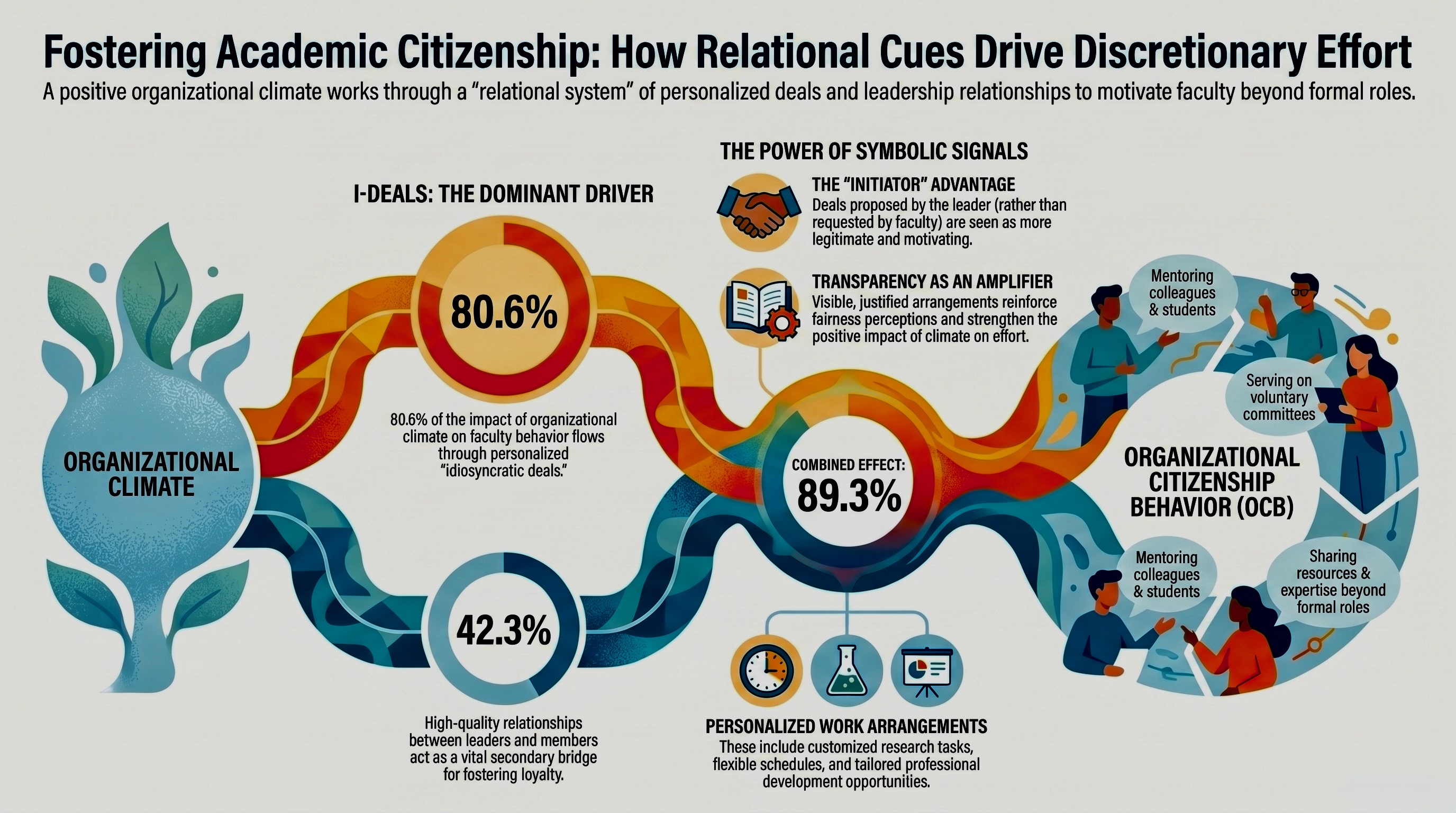
The new research article of our colleagues examines how organizational climate influences the voluntary citizenship behavior of university faculty in Slovakia.
Jankelova NDabić MHalaszovich T (2025), "Organizational climate: citizenship behavior, idiosyncratic deals and leader–member exchange". Management Decision, Vol. 63 No. 13 pp. 600–630, doi: https://doi.org/10.1108/MD-01-2025-0012
The authors utilize a relational signaling framework to demonstrate that a supportive institutional environment encourages extra-role effort primarily through idiosyncratic deals and leader–member exchange.
Findings indicate that these personalized work arrangements serve as critical mediators, especially for senior academics who possess more institutional experience. The study highlights that the transparency of these deals and whether they are initiated by leaders significantly amplify their positive impact on staff engagement. Ultimately, the source argues that academic leadership should prioritize fair, visible, and customized practices to foster a cohesive and resilient academic community.
How do idiosyncratic deals and leader relationships impact academic citizenship?
Idiosyncratic deals (i-deals) and leader relationships, specifically Leader-Member Exchange (LMX), serve as critical drivers of Academic Citizenship Behavior (OCB). In the context of universities, these factors do not operate in isolation but function as a relational system that signals trust, fairness, and professional recognition to faculty members.
The Impact of Idiosyncratic Deals (I-deals)
I-deals are personalized work arrangements—such as tailored research schedules, flexible hours, or specialized tasks—negotiated between a faculty member and their supervisor. They impact academic citizenship in several ways:
- Primary Pathway for Engagement: Research indicates that i-deals are the dominant mechanism through which a positive organizational climate translates into citizenship behavior. In one study, i-deals mediated over 80% of the total effect of organizational climate on OCB.
- Symbolic Recognition: Beyond their practical utility, i-deals carry "symbolic value," signaling that the institution recognizes an individual's specific contributions and professional worth.
- Identity Affirmation: These deals enhance an academic's sense of "thriving" and self-efficacy, making them more likely to engage in discretionary efforts like mentoring colleagues or serving on committees.
- Seniority Sensitivity: The impact of i-deals is often stronger for senior academics (those with higher rank and longer tenure), who may be more attuned to these relational signals as validations of their embedded institutional status.
The Role of Leader Relationships (LMX)
LMX refers to the quality of the exchange relationship between a faculty member and their immediate superior, such as a department chair or dean:
- Foundation for Negotiation: High-quality LMX relationships create the trust-based environment necessary for negotiating i-deals in the first place.
- Mutual Obligation: Strong leader relationships foster a sense of mutual obligation and reciprocity. When faculty feel supported and understood by their leaders, they are more willing to go beyond their formal job descriptions.
- Secondary to I-deals: While LMX is a significant predictor of OCB on its own, it is often a lesser driver than i-deals in academic settings. When both are present, the specific, personalized nature of an i-deal often resonates more strongly with an academic’s professional identity than general relationship quality
Key Factors Influencing Their Impact
The effectiveness of both i-deals and leader relationships in fostering citizenship is heavily dependent on two "symbolic moderators":
- Transparency: When i-deals are implemented transparently rather than secretly, they signal procedural fairness to the wider department. Transparency strengthens the positive relationship between organizational climate and citizenship behavior by reducing perceptions of favoritism.
- Initiator Identity: The impact on citizenship is significantly stronger when leaders initiate the deal rather than the employee requesting it. Leader-initiated deals are interpreted as a genuine expression of trust and merit, whereas employee-initiated deals can sometimes be viewed as opportunistic by colleagues.
In summary, while high-quality leader relationships provide the necessary foundation of trust, it is the personalized, negotiated nature of i-deals that most effectively activates discretionary academic citizenship, provided these arrangements are perceived as fair and legitimate.
Authors: Jankelová, N. Et al. (2025)