Today, electromobility is one of the most important pillars of the automotive industry’s transformation. It is not just a matter of modern technology, but also of social change that has a significant economic, environmental, industrial, and educational impact.
The Faculty of Business Management at the University of Economics in Bratislava is responding to these changes by actively engaging in the development of topics related to sustainable transportation. This is evidenced by Project No. 002EU-4/2025 of the Cultural and Educational Grant Agency (KEGA) of the Ministry of Education, Research, Development, and Youth of the Slovak Republic “Electromobility: A Systems Approach to Transportation Transformation—Development of a College Textbook with an Emphasis on Developing and Enhancing Students’ Knowledge, Skills, Competencies, and Critical Thinking in the Field of Economics and Management.”
A team led by Assoc. Prof. Ing. Patrik Richnák, Ph.D., is working on a project aimed at developing a modern university textbook on electromobility. This publication is intended to help students better understand the connections between economics, technology, and sustainability, and to develop their critical thinking, analytical abilities, and practical skills. Starting in January 2025, the project will incorporate current topics into the curriculum that reflect the dynamic developments in the field of transportation.
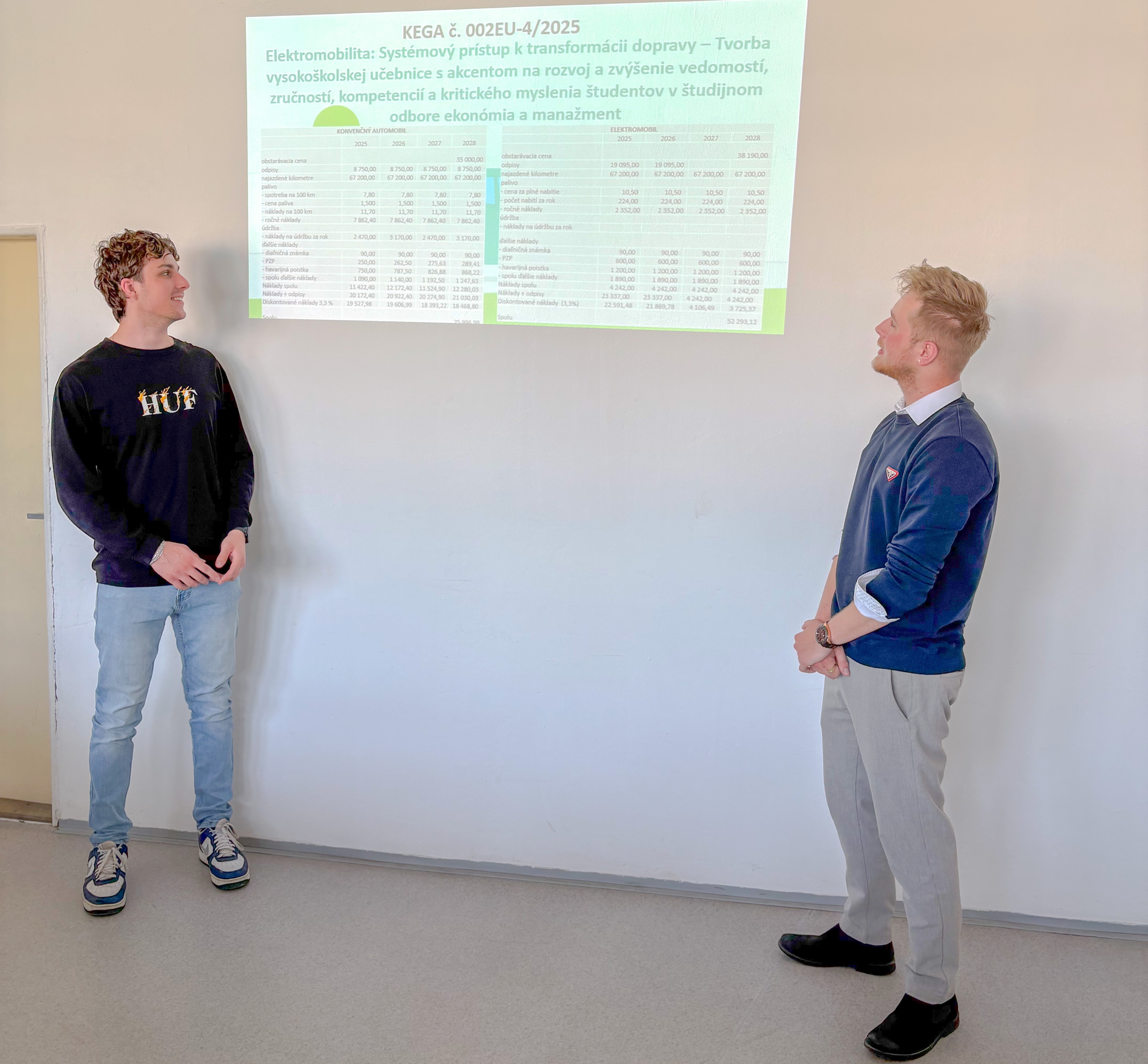
Lenka Kalusová, PhD., a member of the research team, responded to this initiative by incorporating practical examples and model scenarios related to electromobility into her course on Financial Analysis and Financial Planning. First-year students in the second cycle of the Economics and Management program, specializing in General Management, analyzed the financial aspects of electric vehicles in comparison with conventional vehicles.
During the exercise, the students selected two cars with comparable performance—one with an internal combustion engine and the other with an electric powertrain—and analyzed their economic efficiency from a business perspective. Their analysis showed that an electric vehicle may be a more advantageous choice for businesses from a tax perspective, since it can be depreciated over a two-year period (of course, this advantage applies only if the business has a sufficient taxable income base to claim this type of depreciation). It also became apparent that operating an electric vehicle is more cost-effective in the long term, even though its purchase price and accident insurance costs are currently higher.
Through this initiative, Ing. Lenka Kalusová, PhD., emphasized that incorporating the topic of electromobility into the curriculum contributes to shaping the financial mindset of future managers. Through this approach, the Faculty of Business Management at the University of Economics in Bratislava is strengthening its position as a modern educational institution that responds to current challenges and prepares students for a sustainable future.