About Secure E-Business: Why Management Matters More Than Your Security Budget in In Journal of Global Information Management
The rapid expansion of the internet has fueled a massive surge in e-business and e-commerce transactions. However, this growth comes with a significant caveat: every online transaction is inherently linked to the risk of cyberattacks. For modern companies, especially those operating on the electronic market, implementing an Information Security Management System (ISMS) is no longer optional, it is a requirement for survival.
What is an ISMS and Why is it Critical?
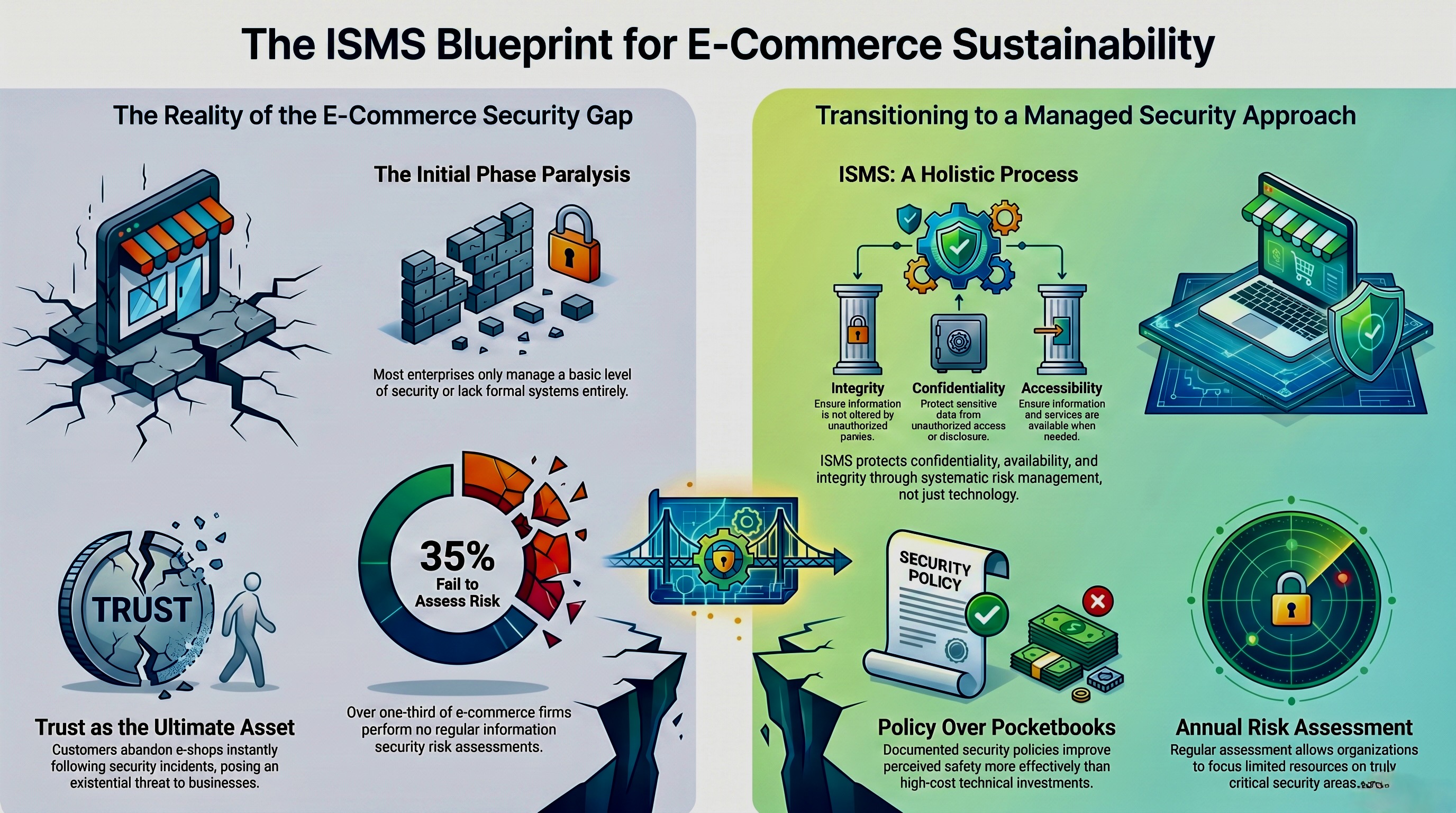
An ISMS is a comprehensive management system that protects the confidentiality, availability, and integrity of information through a rigorous risk management process. In e-commerce, customer trust is the primary currency; a single security breach involving sensitive data can lead to immediate customer loss and potential bankruptcy.
Key Research Findings
Based on a study of e-commerce companies in the Slovak Republic, the following findings highlight the current state of security management and the misconceptions surrounding it:
Spending does not equal security: Surprisingly, there is no statistically significant correlation between the amount of money a company spends on information security and the perceived level of security within that organization.
Management vs. Technology: Organizational measures, such as developing and adhering to an information security policy, can significantly increase security levels with minimal financial investment.
The "Human" Factor: Security relies more on people than on technology. Employees and their behavior are often the weakest element in IT security, making education and awareness essential.
Budget and Risk Management: While higher spending doesn't guarantee a higher "perceived" security level. Companies with larger budgets are statistically more likely to utilize formal risk management measures.
The Implementation Gap: Many e-commerce businesses are aware of the importance of ISMS but lack a comprehensive system. In our study, 25% of enterprises did not address ISMS at all, and 35% did not perform any regular risk assessments.
Micro-Enterprise Vulnerability: Smaller businesses often mistakenly believe they are not targets. While they often lack dedicated security budgets or teams, they remain highly vulnerable to sophisticated attacks.
Strategic Recommendations for Blog Readers
To achieve an adequate level of security without wasting resources, businesses should:
- adopt a Process Approach: use models like PDCA (Plan-Do-Check-Act), which are universally applicable to all business processes and focus on continuous improvement,
- conduct RRA (Regular Risk Analysis): this is the most crucial part of an ISMS. It allows a company to identify critical assets (like customer data and reputation) and focus resources on real threats rather than marginal problems,
- formalize policies: simply having a documented and updated security policy improves ISMS practice and helps manage costs,
- prioritize education: since security is an ongoing process rather than a static state, regular employee training is vital to strengthen the "weakest link",
- Tthe bottom line: you cannot buy your way to a secure e-shop. True security comes from a systematic, procedural approach to management that minimizes risk through appropriate measures at an acceptable cost.
Authors: Bolek, V., Romanová, A., & Korček, F. (2023). The Information Security Management Systems in E-Business. Journal of Global Information Management (JGIM), 31(1), 1-29. https://doi.org/10.4018/JGIM.316833