About Mapping the Future: How Data Science Reveals the Sustainability Leaders of the EU in EKONOMICKÉ ROZHĽADY.
In an era defined by the European Green Deal and a shift toward environmental economics, the question for many nations is no longer just "how much can we grow?" but "how can we grow sustainably?". A recent study published in the Economic Review explores this question by using advanced statistical techniques to group European Union countries based on their human and environmental performance.
Here are the key research findings from their hierarchical clustering analysis of 15 EU nations.
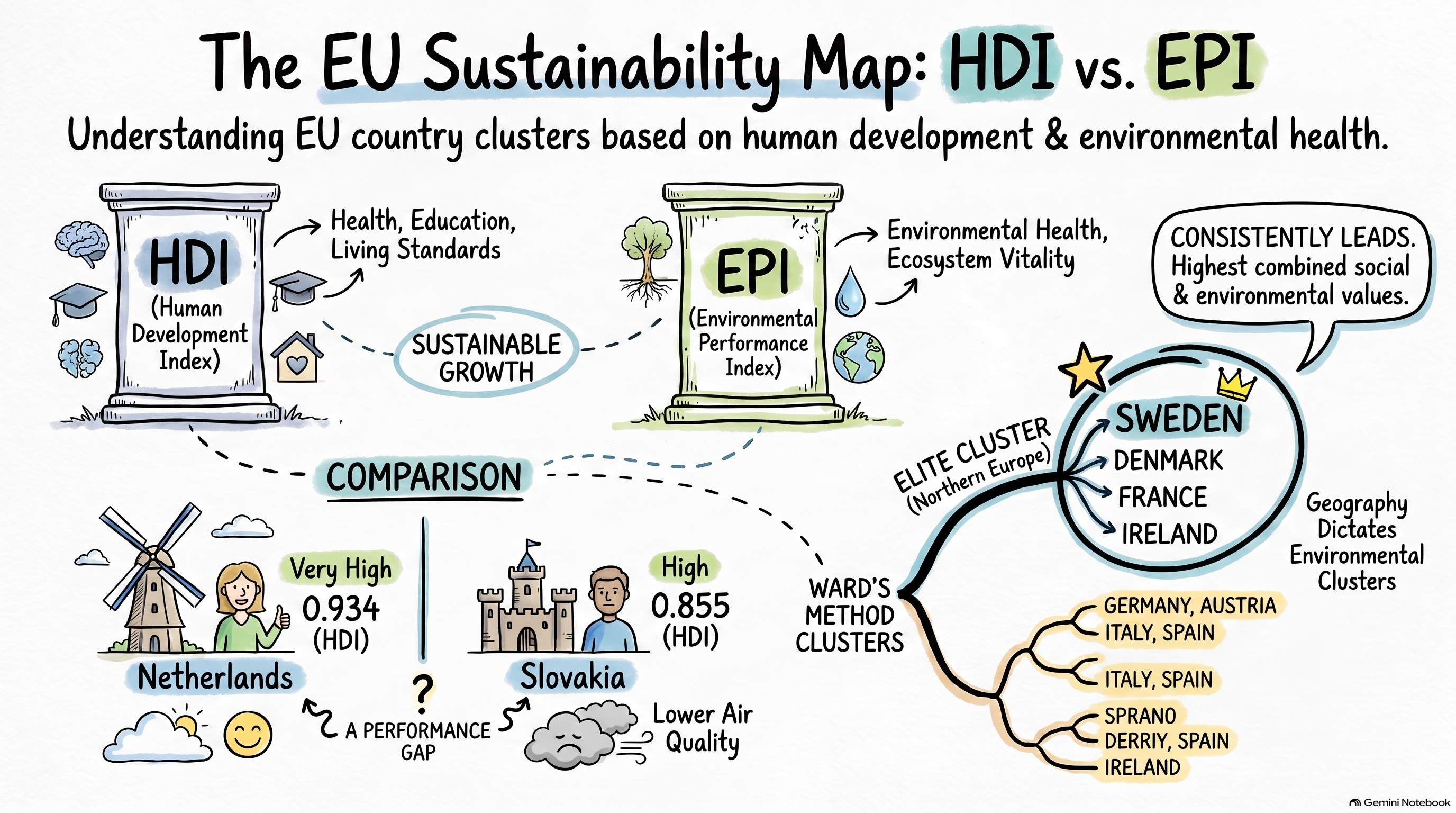
The Measuring Sticks: HDI and EPI
To evaluate "sustainable competitiveness," the researchers focused on two comprehensive indices:
- Human Development Index (HDI): This measures the socio-economic dimension, including health (life expectancy), education, and standard of living (GDP per capita).
- Environmental Performance Index (EPI): This monitors 24 indicators across categories like air quality, water resources, and ecosystem vitality to see how close a country is to its environmental goals
A Tale of Two Countries: Slovakia vs. The Netherlands
The study took a deep dive into the differences between Slovakia and the Netherlands, two countries with similar geographic areas but different development paths.
- Socio-Economic Standing: The Netherlands maintains a "very high" human development level (HDI of 0.934), while Slovakia is classified as "high" (0.855).
- Environmental Strengths: Interestingly, while the Netherlands ranks higher globally (18th in EPI), Slovakia ranks 3rd in the world for "Ecosystem Vitality," largely due to its high scores in biodiversity and habitat protection.
- Resource Management: The Netherlands shines in Water Resources, ranking 3rd globally, whereas Slovakia struggled more with air quality
The Research Findings: Who Leads the Pack?
The core of the research involved hierarchical clustering, a method of grouping objects so that those in the same group are more similar to each other than to those in other groups. By applying methods like the Ward’s Minimum Variance method, the researchers identified distinct "performance tiers" within the EU:
1. The "Super-Performers"
Across all statistical methods, Sweden emerged as the undisputed leader, often sitting in a cluster of its own or leading a small group of highly advanced nations. When using Ward's method, a cluster of the four strongest northern economies appeared: Ireland, France, Denmark, and Sweden. These nations are characterized by:
- Even income distribution and low unemployment.
- Significantly lower greenhouse gas emissions compared to 1990 levels
2. The "Developing Average"
The second, larger cluster included countries like Slovakia, Hungary, Greece, Italy, and the Netherlands. While developed, these nations:
- Have higher greenhouse gas emissions (often above 102% of 1990 levels).
- Need to make more "sustainable efforts" to transition into fully knowledge-based economies.
3. Regional Success Stories
The data revealed that Slovakia and the Czech Republic are currently the top performers among the former communist countries in the EU. Within the Benelux union, the Netherlands maintains a lead over Belgium and Luxembourg in these sustainability metrics.
The Bottom Line
The research confirms a positive relationship between human development (HDI) and environmental behavior (EPI). Improving a country's socio-economic factors, like education and healthcare, naturally drives better environmental outcomes. However, the authors warn that current "average" countries must cooperate across sectors to reach the levels seen in Scandinavia. As the climate continues to change, these data-driven clusters provide a roadmap for which nations are leading the way and which need to accelerate their green transitions.
Authors: REPISKÁ, R., GRISÁKOVÁ, N., ŠTETKA, P. (2022). EKONOMICKÉ ROZHĽADY – ECONOMIC REVIEW, 2022, 51(2), p.149 -170. https://doi.org/10.53465/ER.2644-7185.2022.2.149-170